

GLP-1 has become one of the most talked-about hormones in health and weight management. Most of the attention has come from prescription medications, like Ozempic, that act on GLP-1 receptors. But GLP-1 itself isn’t something created by a pharmaceutical company.
Your body already produces it.
After you eat, specialized cells in the gut release glucagon-like peptide-1, better known as GLP-1. This hormone is involved in several parts of the body’s response to food, including insulin secretion, post-meal blood glucose regulation, stomach emptying, and signals related to appetite and fullness. Since many of the medications can have undesirable side effects, many people are asking: Can you support your body’s own GLP-1 response through nutrition?
New research suggests that the answer may be yes, but there is an important catch: The ingredient matters.
First, What Does Your Natural GLP-1 Actually Do?
When nutrients reach your digestive tract, the body doesn’t simply absorb them and move on. Your gut sends hormonal signals that help coordinate what happens next. GLP-1 is one of those signals.
Among its established physiological roles, GLP-1 helps support blood sugar balance through glucose-dependent insulin secretion and influencing the rate at which food moves through the stomach. Research has also linked GLP-1 activity with appetite and satiety, which is why GLP-1 has attracted so much attention. However, naturally produced GLP-1 behaves very differently from a GLP-1 medication.
Natural GLP-1 Support Is Not the Same as Taking a GLP-1 Drug
Prescription GLP-1 medications such as semaglutide work by mimicking the effects of GLP-1 and activating its receptors for an extended period of time. That long-lasting action is one reason these medications can have such a powerful effect on appetite, digestion, and blood sugar control.
The GLP-1 your body produces naturally works differently. It is released after you eat, helps coordinate your response to that meal, and is then broken down fairly quickly.
So supporting your body’s natural GLP-1 production is not the same thing as taking a prescription GLP-1 medication, but that doesn’t mean that it can’t be beneficial. GLP-1 is part of the body’s normal system for responding to food, helping regulate insulin release, post-meal blood sugar, digestion, and signals related to fullness. This is why researchers are now interested in whether certain nutrients can help support the body’s own GLP-1 response after eating.
For someone interested in supporting GLP-1 naturally, the useful question therefore isn’t: “Is this a natural version of Ozempic?” The answer will always be no.
The better question is: “Has this ingredient actually been shown to support my body’s own GLP-1 response?”
And this is where GLP-1 supplements start to look very different from one another.
The Words “GLP-1 Support” on a Label Don’t Tell You Much
A growing number of supplements now include GLP-1 somewhere in their name or marketing. Some contain fiber. Others contain probiotics, herbs, or broad metabolic blends. Many of those ingredients may have benefits of their own. Fiber, for example, is an important part of a healthy diet. But if your reason for buying the product is specifically GLP-1 support, there are three questions worth asking:
- Which ingredient is supposed to affect GLP-1?
- Has that specific ingredient actually been studied in humans?
- Does the product provide the amount used in that research?
Those questions make it much easier to separate a product that uses GLP-1 as a marketing term from one built around research on GLP-1 itself.
One ingredient now has particularly interesting human evidence.
Researchers Have Been Studying a Specific Type of Collagen Peptide
Collagen probably isn’t the first ingredient you associate with GLP-1. Usually, collagen is discussed in relation to skin, joints, bones, or connective tissue. However, collagen peptides are not all identical.
Researchers screened specific collagen peptide compositions to determine whether any could influence GLP-1 secretion. One composition, now known as Nextida® GC, showed enough promise to move into human research.
A 2024 study published in Food Science & Nutrition first evaluated Nextida GC in laboratory and animal models before testing it in a small human proof-of-concept study involving 16 participants (1).
The results were promising enough to justify a larger and more detailed clinical study.
Then, in 2026, researchers published new human data that gives us a much clearer picture of how these particular peptides may affect the body’s natural GLP-1 response (2).
The 2026 Study Put Natural GLP-1 Support to the Test
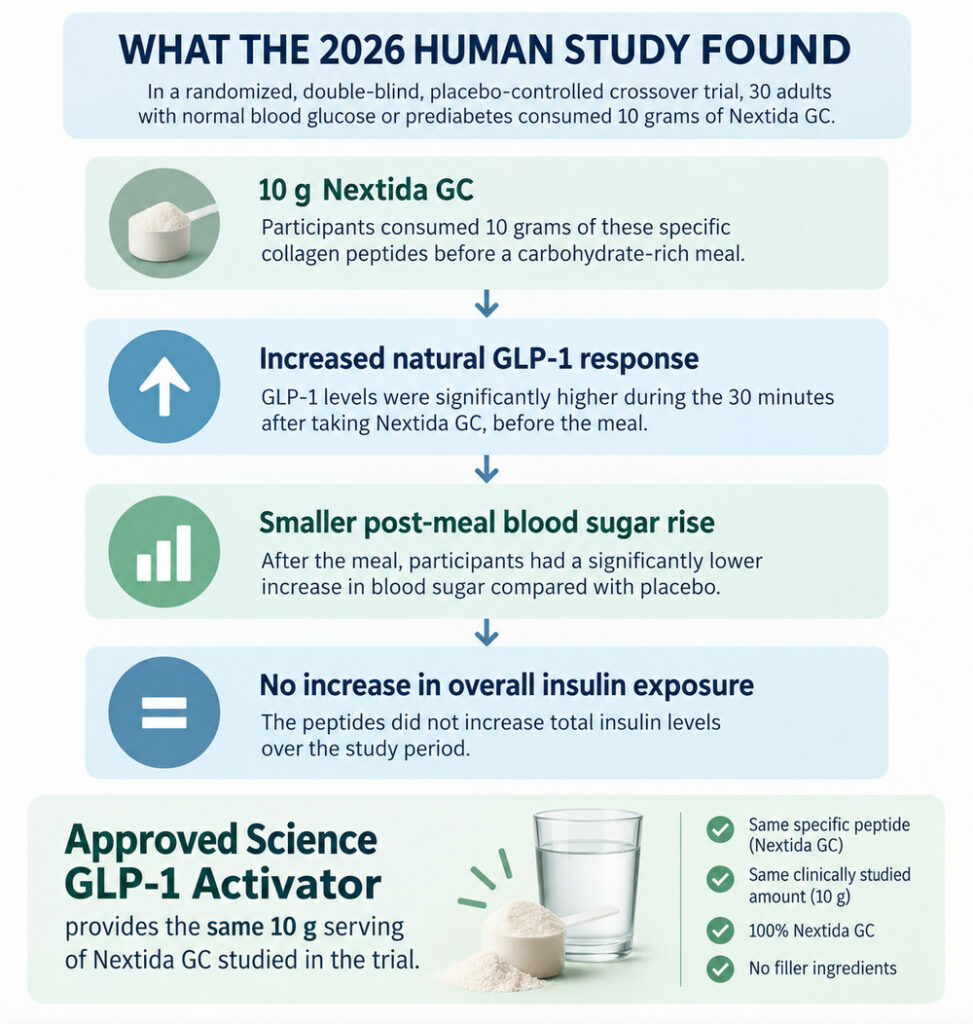
The newer study used a randomized, double-blind, placebo-controlled crossover design (2). Researchers included 30 adults, consisting of 12 participants with normal blood glucose and 18 participants with prediabetes. On the test days, participants consumed either 10 grams of the specific collagen peptides, Nextida GC or a placebo. The supplement was taken 30 minutes before a standardized carbohydrate-rich meal.
Researchers measured GLP-1, blood sugar, insulin, and several other factors before and after the meal.
The first important finding happened before participants even ate. During the 30 minutes after taking Nextida GC, participants had significantly higher GLP-1 levels compared with placebo.
In other words, the peptides weren’t supplying GLP-1. They helped stimulate the participants’ own natural GLP-1 response.
The results of the study were:
1. Post-Meal Glucose Response Improved
After the carbohydrate-rich meal, participants who had consumed the collagen peptides had a significantly smaller rise in blood sugar compared with placebo. This fits with GLP-1’s established role in post-meal metabolic regulation.
2. Overall Insulin Exposure Did Not Increase
One of the particularly interesting findings was that the improvement in post-meal glucose control occurred without an increase in total post-meal insulin. In other words, the metabolic response changed without simply requiring a larger overall insulin response after the meal.
3. The Peptides Helped Food Stay in the Stomach Longer
Researchers also looked at how quickly the stomach emptied after participants consumed the collagen peptides.
Among participants with prediabetes, the collagen peptides helped slow the movement of the test capsule out of the stomach compared with placebo.
Why does this matter? GLP-1 naturally helps slow digestion after a meal. Keeping food in the stomach a little longer may contribute to feelings of fullness and help the body manage the rise in blood sugar after eating.
Does That Mean Nextida GC Has Been Proven to Cause Weight Loss?
No. The current research shows that these specific collagen peptides can increase the body’s natural GLP-1 response and support post-meal glucose regulation. GLP-1 itself plays a role in appetite, stomach emptying, and feelings of fullness. However, the Nextida GC studies were not long-term weight-loss trials.
So while the findings are relevant to processes involved in appetite and metabolic health, they do not prove that Nextida GC causes weight loss or produces the dramatic appetite suppression associated with prescription GLP-1 medications.
This Is Why Approved Science GLP-1 Activator Was Created
When Approved Science developed GLP-1 Activator, we didn’t want to create another general metabolism blend and put “GLP-1” on the label. We wanted the GLP-1 claim to come from the ingredient itself. That’s why Approved Science GLP-1 Activator contains Nextida® GC, the same specific collagen peptide composition evaluated in the human research.
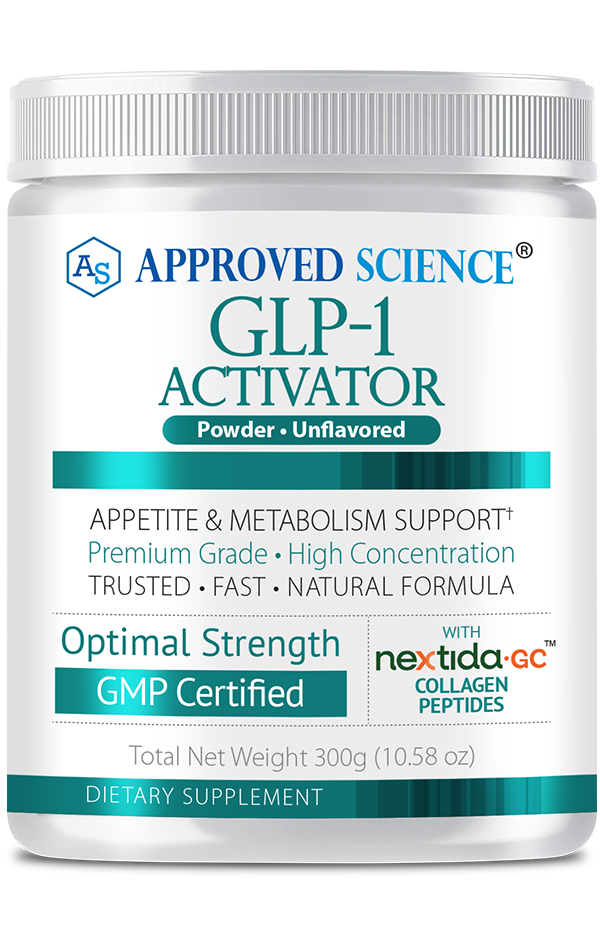
Each daily serving provides 10 grams of Nextida GC, which matches the amount used in the 2026 randomized clinical study. We don’t use a long list of ingredients simply to make the Supplement Facts panel look more impressive. The formula is 100% Nextida GC, without artificial fillers, binders, preservatives, or added flow agents. That simplicity is intentional.
Why 10 Grams Matters
This is one of the easiest details to overlook when comparing supplements. Seeing an interesting ingredient on the label doesn’t necessarily mean you’re getting the amount that was actually researched. In the latest clinical trial, researchers used 10 grams of Nextida GC 30 minutes before the test meal.
Approved Science GLP-1 Activator provides that same 10-gram amount per daily serving. That allows you to compare the product directly with the published research instead of trying to guess whether a much smaller amount is meaningful.
What Can You Realistically Expect From Natural GLP-1 Support?
This is where expectations matter. Approved Science GLP-1 Activator is not a prescription medication, and it isn’t intended to imitate one. Instead, it supports a process your body already uses.
The goal is to support natural GLP-1 signaling and a healthy post-meal metabolic response.
The ingredient doesn’t need an exaggerated promise. It has measurable human data behind the biological pathway it was designed to support. Because GLP-1 is also involved in gastric emptying and signals related to fullness, supporting this pathway may also be useful for people who are trying to better manage appetite as part of an overall healthy lifestyle. However, individual responses can differ.
Before You Buy a GLP-1 Supplement, Read the Ingredient List
GLP-1 may be one of the biggest health trends right now, but a word on the front of a bottle doesn’t always tell you what’s inside it. Before buying any GLP-1 supplement, look past the product name. Ask what ingredient is responsible for the claimed GLP-1 support. Look for human research on that specific ingredient. Then check whether the formula contains an amount that reflects the research.
Approved Science GLP-1 Activator was built around those exact questions.
It contains 10 grams of clinically studied Nextida GC with no unnecessary additives, in an unflavored powder that can be easily incorporated into a daily routine.
For people interested in nutritional support for their body’s natural GLP-1 response, Approved Science GLP-1 Activator offers a targeted approach built around a clinically studied ingredient at the amount used in human research. That’s very different from simply buying the latest supplement with “GLP-1” printed on the label.