

Bovine colostrum has become one of the biggest wellness trends of 2026. It has appeared across social media, celebrity routines, powders, gummies, and supplement shelves, with promises involving everything from gut health and immunity to recovery and glowing skin. U.S. sales have surged as colostrum has moved from a niche sports supplement into mainstream wellness.
So what’s driving this seemingly odd behavior and is the colostrum craze scientifically sound?
First, What Exactly Is Colostrum?
Colostrum is the first milk mammals produce after giving birth, before regular milk production begins. It is specifically designed to nourish and protect a newborn during its earliest days of life. Compared with regular milk, bovine colostrum contains a concentrated mixture of proteins and bioactive compounds, including immunoglobulins such as IgG, lactoferrin, peptides, and growth factors.
That explains why newborn calves need it. But it raises the obvious question: Why would any of this matter to an adult human?
The answer may have a lot to do with where those compounds go after you swallow them.
Your Gut, Not Immune System, May Benefit Most
You may have heard that colostrum contains antibodies and assumed those antibodies somehow enter your bloodstream and strengthen your immune system. That isn’t exactly how it works. Instead, researchers are studying what colostrum’s proteins and other bioactive compounds may do within the gastrointestinal tract itself.
Your intestinal lining performs a difficult balancing act every day. It needs to allow nutrients to pass through while maintaining a barrier against substances that should remain inside the digestive tract. This barrier can temporarily become more permeable under certain types of stress, including the physical stress that athlete’s experience.
What Human Studies Have Found
A 2024 systematic review and meta-analysis examined randomized clinical trials involving bovine colostrum and individuals with increased intestinal permeability (also known as leaky gut). The researchers found that colostrum supplementation was associated with significant improvements in commonly used measures of intestinal permeability. They also stressed that more research is needed because studies have used different doses, products, durations, and populations. (1)
In other words:
The evidence isn’t strong enough to call colostrum a cure for “leaky gut.” But there is enough human research to make gut barrier support one of the most compelling reasons scientists are studying colostrum in adults.
That distinction matters. Colostrum isn’t scientifically interesting because it contains a long list of vitamins that you could easily get somewhere else. What makes colostrum unique is that it contains a complex collection of biologically active proteins and compounds that may interact with the digestive environment in ways ordinary milk does not.
What About Immune Support?
Colostrum may also help support your body’s natural defenses, especially during periods of physical stress. It naturally contains IgG, lactoferrin, and other immune-supporting proteins that help your body respond to everyday challenges.
In one systematic review of five randomized controlled trials involving 152 physically active adults, people taking bovine colostrum experienced 44% fewer days with upper respiratory symptoms and 38% fewer symptom episodes during exercise training. (2)
That could mean more days feeling well, fewer interruptions to your routine, and extra support when your body is being pushed harder than usual.
Combined with the research on gut barrier support, these findings help explain why so many adults are turning to colostrum for daily gut and immune support.
Colostrum On The Label Doesn’t Tell You What You’re Actually Getting
Imagine comparing two supplements.
One says:
3,000 mg Bovine Colostrum
Another says:
3,000 mg Bovine Colostrum, Standardized to 30% IgG
They sound similar, but the second one has more information. Why?
It’s because colostrum isn’t a single purified ingredient. It is a naturally variable biological material. Its composition can differ depending on factors such as the cow, breed, feeding, timing of collection after birth, and manufacturing conditions. IgG levels and other bioactive compounds can change substantially during the first few days after calving.
For example, researchers who compared commercially available bovine colostrum products found marked differences in biological activity between products. The researchers warned that simply describing a dose in grams of colostrum may not give enough information to meaningfully compare one product with another. (3)
That’s a very important lesson if you’re shopping for colostrum: A bigger scoop doesn’t automatically mean a better colostrum supplement.
The Number Colostrum Shoppers Should Look For: IgG
One of the clearest markers you can actually look for on a colostrum label is its IgG concentration. IgG stands for Immunoglobulin G, which is the dominant antibody found in bovine colostrum. That’s why IgG percentage is one of the most useful numbers to check when comparing colostrum supplements. It tells you how concentrated the product is in one of the key components that makes colostrum different from ordinary milk.
For example:
A 3,000 mg serving standardized to 30% IgG provides 900 mg of IgG. Without standardization, a bottle that says “3,000 mg colostrum” might have significantly less IgG than you expect.
What To Look For In A Colostrum Supplement
If you decide to try colostrum, don’t choose one simply because the container has the biggest milligram number on the front.
Look for three things.
- 1. Clearly Stated IgG Standardization – You should be able to see how concentrated the colostrum is, not simply how many grams of powder are in each serving. A clearly disclosed IgG percentage lets you calculate how much IgG you’re actually getting.
- 2. Clean, Traceable Sourcing – Colostrum comes directly from dairy herds, so its source matters. Look for information about how the cows are raised and whether the manufacturer clearly discloses its sourcing and quality standards.
- 3. Quality Testing – Research has shown substantial variability between commercial colostrum products. That makes manufacturing standards and independent testing particularly important when choosing a supplement.
Why We Made Approved Science® Colostrum Different
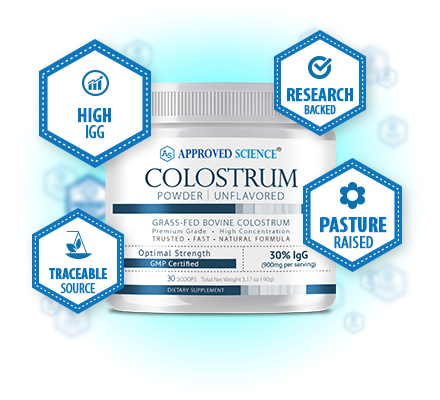
These are exactly the issues we considered when formulating Approved Science® Colostrum Powder. Each serving provides 3,000 mg of premium bovine colostrum standardized to 30% IgG. So instead of simply knowing how much powder is in your scoop, you know the amount of IgG that serving is designed to provide. Each serving provides 900 mg of IgG.
The colostrum is sourced from grass-fed, pasture-raised dairy herds and produced without rBST, antibiotics, GMOs, or BSE. It’s also a pure, unflavored powder with no added ingredients or fillers, so it can easily be mixed into water, milk, yogurt, or a smoothie.
Approved Science® Colostrum is manufactured in the USA in a cGMP-certified facility and undergoes independent third-party testing.
The idea is simple:
If you’re taking colostrum for the compounds that make colostrum unique, you should know how much you’re actually getting.
Where Can You Buy Approved Science® Colostrum?
Approved Science® Colostrum Powder is available directly from the official Approved Science website.
Buying directly from Approved Science® also gives you a 60-day money-back guarantee, so you can try it and decide later whether colostrum belongs in your daily routine.
>>> Try Approved Science® Colostrum Powder with 30% IgG
The Bottom Line
So why are adults taking something originally made to nourish newborn calves?
The answer isn’t that colostrum is a miracle food. It’s that colostrum contains an unusual collection of immunoglobulins, lactoferrin and other bioactive compounds, and researchers have found some particularly encouraging results involving gut and immune health.
Look beyond the word “colostrum.” Check the IgG concentration. Check the sourcing. Check the testing. Find out what is actually in each serving.
Approved Science® Colostrum gives you 3,000 mg of grass-fed bovine colostrum standardized to 30% IgG, providing 900 mg of IgG per serving. If you’re going to try one of 2026’s biggest wellness trends, choose one that gives you more than a big number on the label. Choose one that tells you exactly what you’re getting.